To Serve, Protect and Reassure

It was the year 1705 that Ligon, the historian on a visit to Barbados recorded that there were plans to establish a watch of eight divisions each headed by a Constable to police Barbados. In the year 1813, the House of Assembly directed the St. Michael’s Vestry to raise a sum of money to establish a Bridgetown Watch of twenty-four able bodied men to work from 7.00 p.m to 6.00 a.m and the following year Rules and Regulations for the control of the members of the Watch were drawn up.
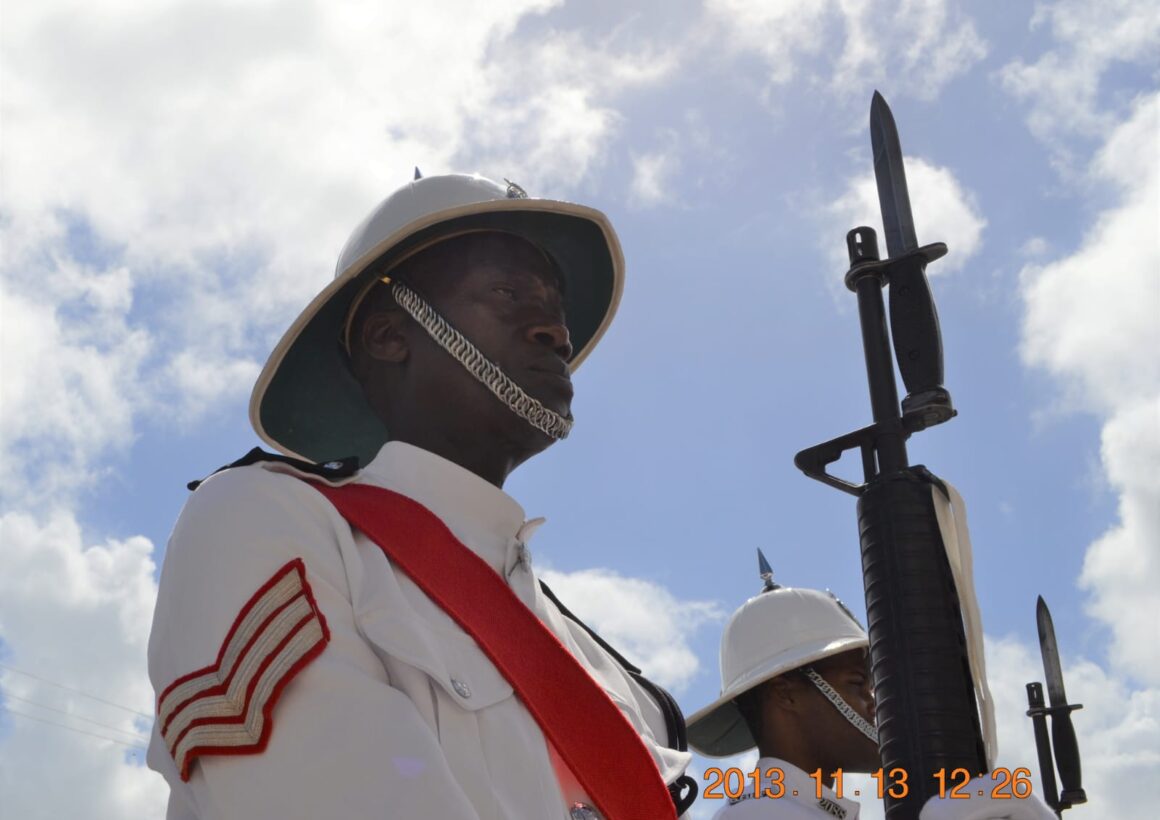
In 1834, twelve Constables were appointed to process all court matters of the Quarter Sessions and as an incentive; they were not required to perform the duties of the Watch during the night. It was in that same year that two acts were passed for the establishment of the Bridgetown Police under the command of Frances Mayal Mallalieu of the Metropolitan Police of London for the establishment of the Rural Police, who would be under the command and control of eight legislators of the House of Assembly, and these would be known as Commissioners. The two acts did not receive the approval of Westminster.

On December 15th 1835, a consolidated Police Act was passed, making provision for the establishment of a single Police force of 225 mounted and foot patrols, one Inspector and one Inspector General in the person of Mr. Frances Mayal Mallalieu. Police Stations were sited at District A in St. Michael; District B for Christ Church and St. George; District C for St. Philip and St. John; District D for St. James and St. Thomas; District E for St. Peter and St. Lucy; District F for St. Joseph and St. Andrew; the Denmark Fort in Speightstown and James Fort in Holetown.

Two years later, a number of changes took place: the number of mounted men at the district stations were increased over the number of the foot patrols; the Force had an increase in numbers; the wearing of chevrons on both arms was instituted; ankle boots took the place of shoes; a fire company was added to the Force and changes were introduced in the method of selection of recruits for the Force.

In 1845, the Criminal Investigations Division was established with a dozen experienced constables, who came from the foot patrols. In 1867, the Harbour Police were established, but under the command of the Comptroller of Customs, but in 1880 they were amalgamated with the land police and came under the control of the Inspector General of Police. In 1889, the Police Band was established.

The Criminal Records Office was established in 1905 and a new Police Act was passed in 1908 with an establishment of one Inspector General, two Inspectors, two Sergeant Majors, thirteen Sergeants, twenty-four Corporals and three hundred and eighty-five Constables. In 1919, the rank of Lance Sergeant was introduced and that same year, the St. Michael’s Vestry gave the police permission to use the grounds at Queen’s Park for games. In the 1920’s a change in the appellation of some ranks took place because  the establishment then was given as one Colonel, two Captains, two Sergeant Majors, thirteen Station Sergeants, thirteen Lance Sergeants, twelve Corporals, three hundred and sixty-eight Constables, thirty-six Writ Servers and four Supernumeries.

With the arrival of Colonel William S. Dickens, a number of changes were introduced. He became the last Inspector General and the first Commissioner of Police, the rank of Deputy Commissioner was added, the Traffic Branch formed, the Harbor Police got its first motor launch, the telecommunications system was implemented and the Police Sports Club took over from P.A.L.S. as the controlling body for the promotion of games and the main provider of recreational facilities for the members of the Force.

The early 1960’s saw the appointment of the Date Commissioner of Inquiry into the Force. Captain Wilfred Farmer would be the last Commissioner of Police who would have joined the force at gazetted level and in 1966, the Barbados Police Force became the Royal Barbados Police Force, following the visit of Her Majesty Queen Elizabeth 11. The rank of Assistant Commissioner was introduced and in 1972, Mr. Girwood Springer became the first Commissioner of Police who had worked his way up through the ranks, albeit with a period of his service being spent in the Trinidad and Tobago Police Service. By the end of the 1970’s, Mr. Aviston Prescod became the first Commissioner of Police who had served his entire service in Barbados.