To Serve, Protect and Reassure

From the inception of the Police Force in 1835, horses were used. However, the Mounted Corp as it was then called, was organized as a unit of the Force in 1880 and supervised by Major L. Lawrence in whose honour the riding school at District A is named.

The training of the Corp was done at the District A Police Station, which has remained the headquarters of the Mounted Branch until present. After training, men and horses were transferred to the Central Police Station as well as the rural stations; District B, C, D, E and F. Of these stations, B and C are still operational.

During the early years of the Force, personnel including Sergeants who had the ability to ride were posted at rural stations where horses were kept. Due to limited means of transportation, the horses were a valuable asset to the Force’s operations, particularly patrolling the various outlying districts.

On Fridays, the Mounted Corp were required to perform a “Manager Patrol”. This was covering the country roads, ensuring that the managers of the plantations were not robbed of the workers’ payroll. In those days, the general form of transportation was provided by horse drawn vehicles and carts, which were kept at district stations for the conveyance of prisoners and forage. The Mounted Police also provided transport of correspondence for other government departments.

During the 1930s, the Mounted Corp was provided with a programme of training to improve their efficiency and standard. Through this programme, all mounted men and horses had to return to District A for training in the areas of jumping, tent pegging, troop drill, bare back riding, truncheon drill and lance drill. It was during the decade of the 1930s that the musical ride was introduced. These displays were held at Queen’s Park, King George V Memorial Park. This not only provided amusement but also improved the police public relations. During those days it was not unusual to see men on route marches or cross-country rides.

In 1933, colonel W. S. Dickens renamed the Corps the “Mounted Branch” and it consisted of one (1) sergeant and thirty-one (31) N.C.)’s and constables.The Mounted Branch in those days could be seen participatingat race meets of the Barbados Turf Club. This tradition of the mounted police at the races is still maintained, primarily for crowd control duties. As the motoroized fleet of the force expanded, the strength of the Mounted Branch was reduced.
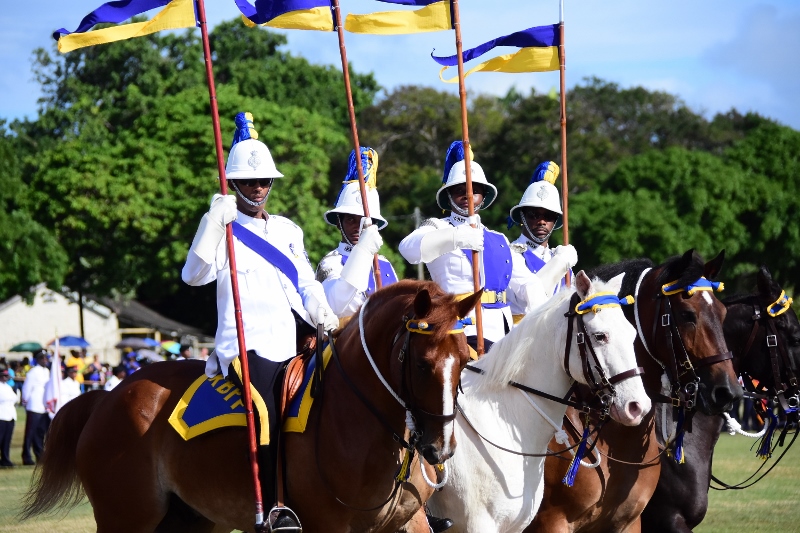
In 1967, the personnel of the Mounted Branch had their first overseas tour, participating in EXPO ’67 in Montreal, Canada. The Mounted men can be seen participating in musical rides at tattoos and official escorts to the Queen on her visits to the island ormher representative the Governor General.

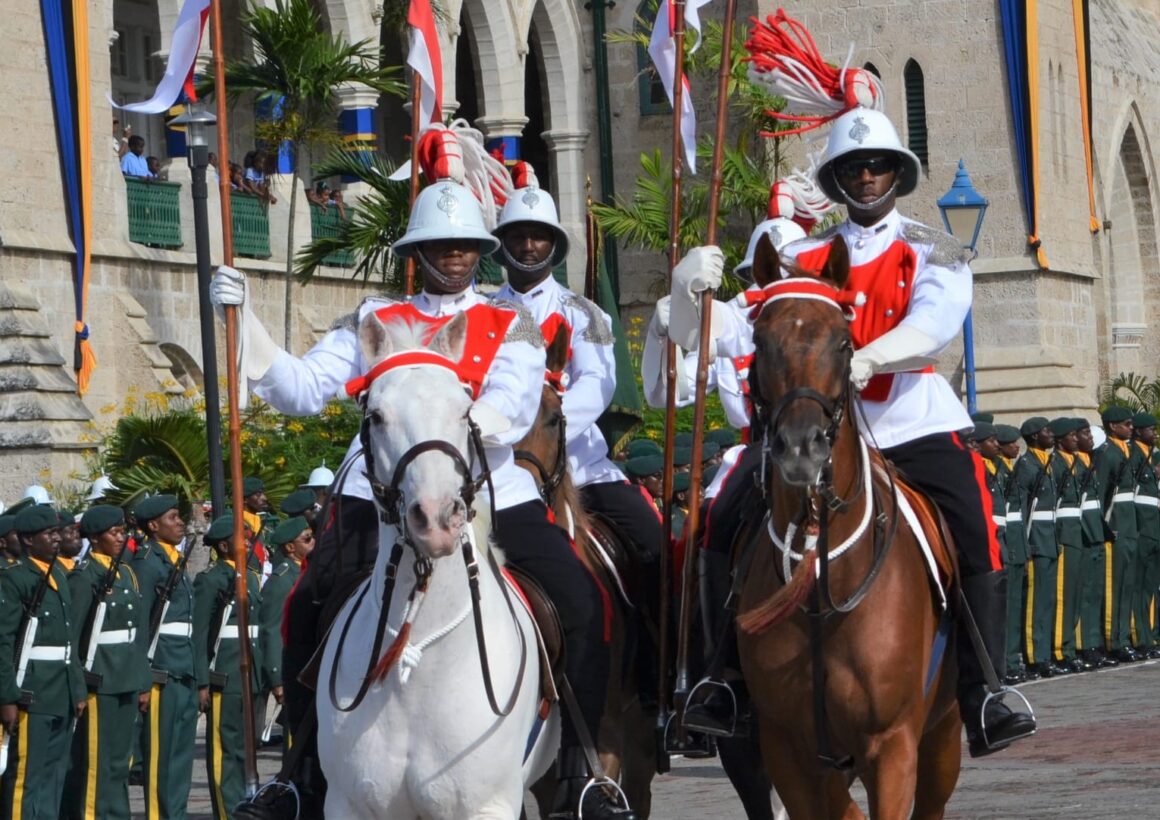
The ceremonial uniform of the Mounted Branch is the direct effort of Captain W.H.R. Armstrong where he wanted the escort uniforms to appear similar to that of the queen’s Horse Guard, with plume, pointed helmets, chain straps, shoulder chins and lances.
The role and duties of the Mounted Branch

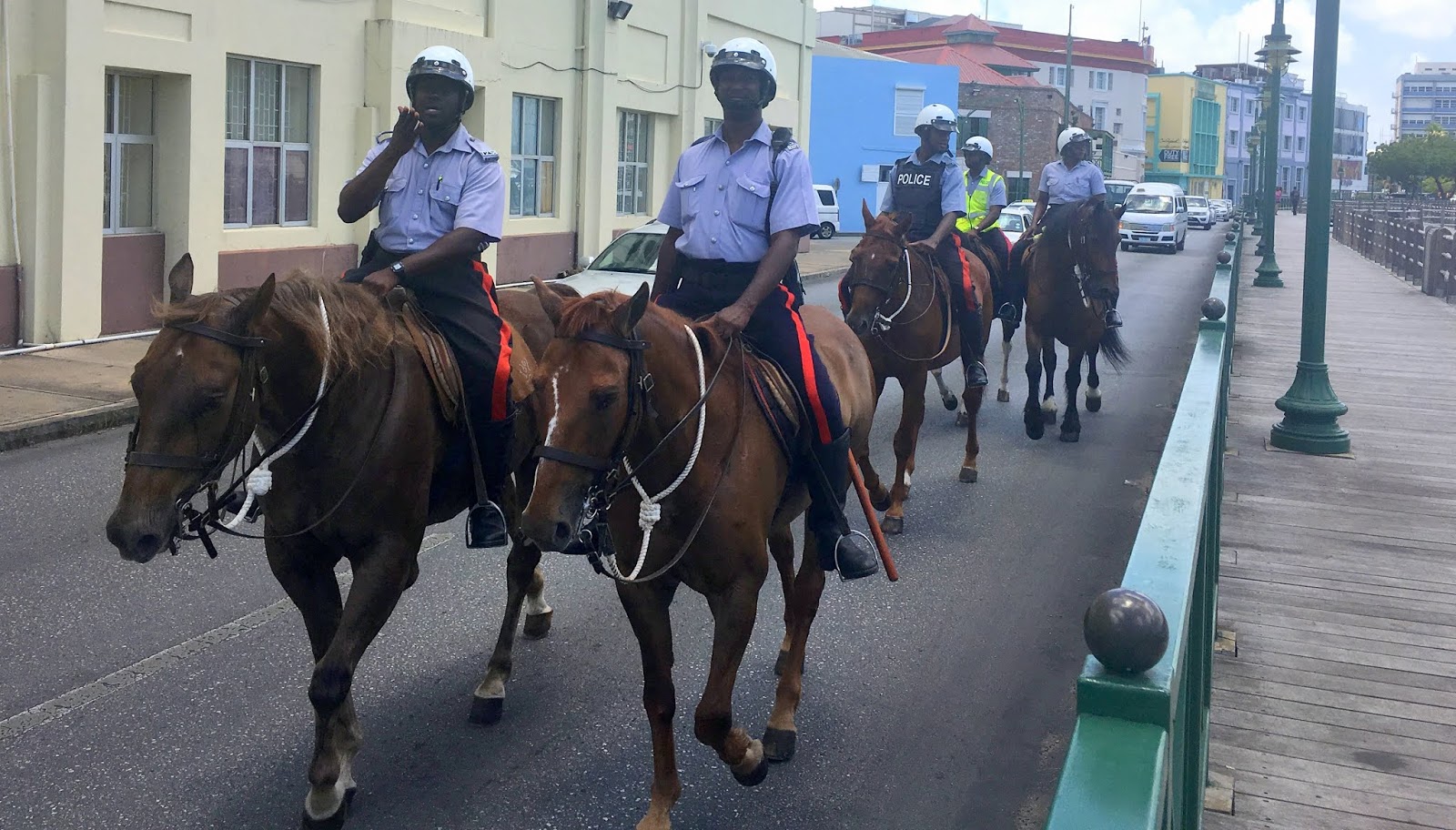
The role of the Mounted Branch has varied since its inception. The present day Mounted Police patrol the beaches and districts as a means of preventing crime and it is one of the public relation arms of the force. One of the major roles of the Mounted Branch is to escort the Governor General at parades and the opening of Parliament, since the Mounted Branch is the official escort to the queen and her representatives. The Mounted Branch is also used as crowd control at events such as Crop Over, sporting events and major entertainment shows. They are capable when trained of affecting the quiet and systematic dispersal of disorderly crowds without resorting to use of force of any kind.

RECRUITMENT/TRAINING

Personnel for recruitment to the Mounted branch must be members of the Royal Barbados Police Force with not less than two years’ service. They must possess a rounded knowledge of policing and have a love for horses. On applying, persons are interviewed and their suitability is determined by the administration of the Mounted Branch. Thereafter, they would commence an initial six (6) months training period. During this time, they would be exposed to the basics of riding under the watchful eye of a designed trainer who would also instruct them on the grooming, care, feeding and finer points of the horse and saddlery.

WORKING AND CEREMONIAL DRESS

The daily dress for the officer comprises the gray shirt, blue breach, black boots and putties as well as spurs. While the horse would be dressed in a brown leather head top, a white rope, a brown blanket and brown saddle.

The dress for the officer comprise a red and white plume attached to the white helmet with silver chin strap, white long sleeve tunic with silver shoulder chains, a red pastern (breast plate), a pair of white gonlets (gloves), blue breach and a pair of knee high jack boots and spurs. He would carry a lance which has a red and white pendant. While the horse would be dressed in a brown leather head top, white rope, a red and white brow band, a red and brown beard, silver ceremonial chain, red and white blanket, a sword and a brown leather saddle.

HORSES

Horses are primarily imported from Canada and the United Kingdom while some are locally bred. Stallions are not used by the Branch because of their temperament. Mares and geldings are used for police work and they are mainly half quarter horses and half thorough breeds and must be fifteen to eighteen hands in height and of good configuration. The training of the horses is done by designated members of the Mounted Branch. Each Mounted person is assign to a horse and has the responsibility to take care of his or her horse and saddlery. This involves the grooming of the horse and cleaning of the stall and ensuring that the horse is well fed and nurtured.

THE STABLE

The Fitzherbert Bancroft Stable which is located on the District A Complex was officially opened on August 15, 1991 and is the headquarters of the Mounted Branch. The stable is capable of housing twenty-six (26) horses and is outfitted with all the necessities for the comfort of the horses. The Fitzherbert Bancroft Stable is also the home of the CJ Lawrence Riding School. This school takes its name from an outstanding mounted officer who passed through the Mounted Corp  as it was then called. On walking the corridors of the stable you would come upon a sign that reads “ Seon Woodroffe Walk”. This is where you would find the office of the resident farrier who plies his trade with precision, skill and dedication as he prepares the horses for their working life in the Royal Barbados Police Force.

From the inception of the force the Mounted Branch has played a vital role in the policing of our island and while this role has changed, it continues to meet the needs of a modern society. The Branch continues to be of invaluable service to the Royal Barbados Police Force. They provide entertainment and amusement to Barbadians and visitors alike , thereby enforcing good community relations.